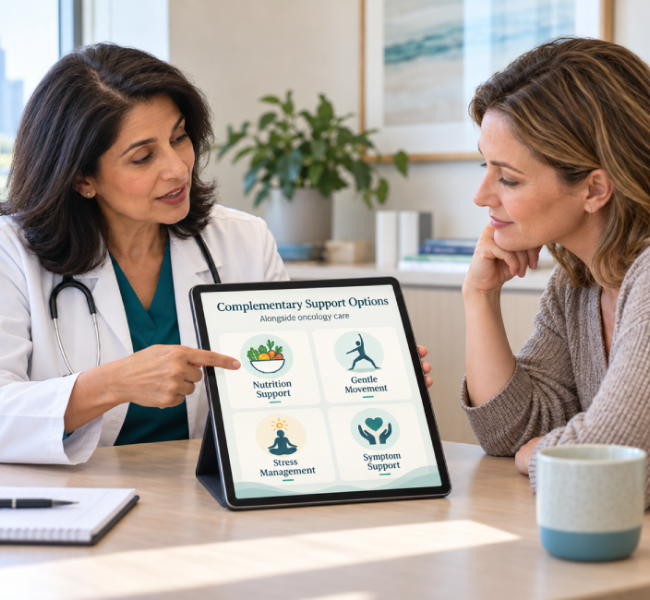
Whole-Person Support for Houston Cancer Patients
Between oncology visits, Houston cancer patients often face unanswered questions about fatigue, supplements, nutrition, and recovery. Without structured guidance, those concerns can affect daily life and treatment decisions.
At Internal Healing & Wellness MD, Houston-area patients can access physician-led integrative cancer support from our Shenandoah clinic, near The Woodlands. We do not provide chemotherapy, radiation, surgery, or other cancer-directed treatment — that care stays with your oncology team. Patients seeking integrative cancer support can explore personalized options tailored to their current treatment stage and recovery needs.

Disclaimer: This information is for educational purposes only and is not intended as medical advice. It does not replace, delay, or substitute standard oncology care, screening, diagnosis, or treatment recommended by your oncology team.
Medical review pending: Dr. Imran Khan, MD, IFMCP | Last medically reviewed: October 15, 2026

Integrative Care Built Around Your Treatment
For Houston cancer patients, integrative oncology adds complementary support to a conventional treatment plan. Surgery, chemotherapy, radiation, immunotherapy, targeted therapy, or hormone therapy remain focused on treating the cancer.
Integrative care is guided by:
- Supportive Purpose: Addresses needs arising around treatment.
- Safety Review: Checks for treatment interactions and clinical risks.
- Care-Stage Fit: Considers treatment timing, recovery, and monitoring.
- Patient Context: Reflects the diagnosis, symptoms, medications, and goals.
The National Cancer Institute distinguishes complementary care, used alongside standard treatment, from alternative care, used instead of it. Our support works alongside the plan your oncology team has set and never replaces it.
If You Have Stepped Away From Conventional Care
Some patients come to us having lost confidence in their oncologist or having stopped treatment altogether. We take those concerns seriously. A meaningful part of this work is helping patients re-engage with standard cancer care on terms they can accept.
If you are not currently working with an oncologist, or that relationship has broken down, tell Dr. Khan. He will go through the options with you.
Cancer Testing Within Integrative Care
Houston-area patients may have pathology, imaging, laboratory results, and treatment records from several providers. Reviewing these findings helps determine whether another test could answer a specific supportive-care question.
Reviews may draw on several types of clinical information and cancer testing:
Existing Cancer Results
Pathology, imaging, tumor markers, and treatment notes provide the clinical foundation for integrative cancer support.
Functional Laboratory Review
Selected nutrient, metabolic, digestive, or hormone tests may help personalize symptom and recovery guidance. They do not diagnose or stage cancer.
Functional Tumor-Cell Testing (RGCC or Datar Cancer Genetics)
Depending on the selected panel, RGCC testing or Datar Cancer Genetics chemo-sensitivity testing may examine circulating tumor cells and how patient-derived cancer cells respond to selected agents outside the body. Dr. Khan recommends whichever fits the individual case.
Results may inform discussions about supportive and repurposed agents, but cannot predict how an individual patient will respond. They do not replace validated pathology, imaging, or oncology-directed testing.
Each test should answer a defined question and be interpreted within the patient's broader cancer plan.
Personalized Integrative Cancer Support in Houston
Symptoms and recovery needs can change throughout cancer care. We tailor support to what each patient is managing now.
Depending on treatment stage and current needs, support may include:
- Nutrition Guidance: Addresses appetite, digestion, weight, and strength
- Supplement Review: Checks vitamins and herbs for treatment interactions.
- Infection and Blood Count Review: Reviews counts, infection precautions, and recovery needs alongside your oncology team's monitoring.
- Lifestyle Planning: Adjusts movement, sleep, and hydration to current capacity.
- Mind-Body Support: Helps patients manage stress, coping, and sleep disruption.
ASCO and the Society for Integrative Oncology recommend exercise, cognitive behavioral therapy, mindfulness-based programs, and tai chi or qigong to reduce cancer-related fatigue during treatment (Bower et al., 2024).

Complementary Cancer Therapy Options in Houston
Cancer patients may need added support for hydration, physical discomfort, or quality-of-life concerns. When clinically appropriate, complementary cancer therapy options may include:
- IV Nutrient Support: May address hydration or identified nutrient needs after medical and interaction screening. It is not a cancer treatment.
- Myofascial Release Therapy: Discuss whether hands-on support is appropriate given recent surgery, blood counts, bone health, and medical devices. The SIO–ASCO pain guideline addresses massage in defined oncology settings; it does not establish benefits for this specific myofascial-release service (Mao et al., 2022).
Each option is reviewed in relation to the diagnosis, medications, treatment stage, and clinical risks. These therapies support patient well-being but do not treat the cancer itself.
Practical Benefits of Integrative Cancer Support
Cancer patients can face unanswered questions between treatment visits. Through physician-led integrative cancer support, we help organize those concerns into practical, treatment-aligned next steps.
Patients may gain:
- Less Guesswork: Clarifies which supportive concerns need attention.
- More Informed Decisions: Provides context for tests, supplements, and therapies.
- Practical Daily Support: Turns clinical guidance into manageable routines.
- Stronger Care Communication: Helps patients prepare focused questions for their oncology team.
- Continuity Through Recovery: Adjusts support as symptoms and treatment stages change.
These benefits focus on supportive care, informed decisions, and quality of life. They do not establish that integrative therapies control cancer or extend survival.
Clinical Oversight for Integrative Care
Cancer patients need supportive guidance that reflects their diagnosis and current treatment. We provide integrative cancer support with attention to safety, clinical context, and changing needs.
Our approach includes:
Physician-Led Care
Board-certified internal medicine physician in practice since 2011, with residency training at Case Western Reserve University / MetroHealth and practice experience at Cleveland Clinic, Baylor St. Luke's Medical Center, and Memorial Hermann Memorial City. Certified by the Institute for Functional Medicine.
Treatment Alignment
Supportive recommendations shaped around the current cancer plan.
Clinical Review
Considers symptoms, laboratory findings, medications, and care stage together.
Safety Checks
Reviews supplements and complementary therapies for dosing and interaction concerns.
Ongoing Adjustment
Adapts guidance as treatment, recovery needs, and goals change.
Houston-Area Access
Serves patients from Houston, The Woodlands, Conroe, Spring, Tomball, Magnolia, and surrounding areas through our Shenandoah clinic.
Start Integrative Cancer Support With Medical Guidance
Cancer care can leave patients carrying symptoms and health questions that no longer fit neatly into an active treatment visit. At Internal Healing & Wellness MD, patients from Houston can receive physician-led integrative cancer support through our Shenandoah clinic near The Woodlands.
Book a consultation for guidance aligned with your current oncology plan.
Frequently Asked Questions
The visit reviews your diagnosis, current treatment, symptoms, medications, supplements, laboratory findings, and supportive-care goals. This helps identify appropriate next steps and whether additional testing may be useful.
Yes. An early consultation allows time to review nutrition concerns, supplements, and proposed complementary therapies before treatment begins. Recommendations remain coordinated with the treating oncology team.
Frequency depends on your treatment stage, symptoms, testing, and goals. Follow-up may be more frequent during active treatment and less frequent during recovery or survivorship.
Tell the integrative care team about new medications, procedures, or schedule changes. Supplements, complementary therapies, and recovery guidance may need to be adjusted for safety.
No. Recommendations depend on the diagnosis, treatment stage, symptoms, medical history, and clinical goals. Some patients may benefit from personalized guidance without additional testing or therapies.
References
-
Mao JJ, Ismaila N, Bao T, et al. Integrative medicine for pain management in oncology: Society for Integrative Oncology-ASCO guideline. J Clin Oncol. 2022;40(34):3998–4024. https://doi.org/10.1200/JCO.22.01357
-
Bower, J. E., Lacchetti, C., Alici, Y., Barton, D. L., Bruner, D., Canin, B. E., Escalante, C. P., Ganz, P. A., Garland, S. N., Gupta, S., Jim, H., Ligibel, J. A., Loh, K. P., Peppone, L., Tripathy, D., Yennu, S., Zick, S., & Mustian, K. (2024). Management of fatigue in adult survivors of cancer: ASCO–Society for Integrative Oncology guideline update. Journal of Clinical Oncology, 42(20), 2456–2487. https://doi.org/10.1200/JCO.24.00541
-
National Cancer Institute. (n.d.). Complementary and alternative medicine. Retrieved October 6, 2026, from https://www.cancer.gov/about-cancer/treatment/cam