


Why GHK-Cu Is Gaining Attention in Skin and Hair Research
One of the lesser-known facts about the GHK-Cu peptide is that it was first identified in human plasma, where researchers observed that its levels naturally decline with age.
This discovery sparked decades of research into GHK-Cu benefits, particularly its potential role in skin repair, tissue repair, and wound healing.
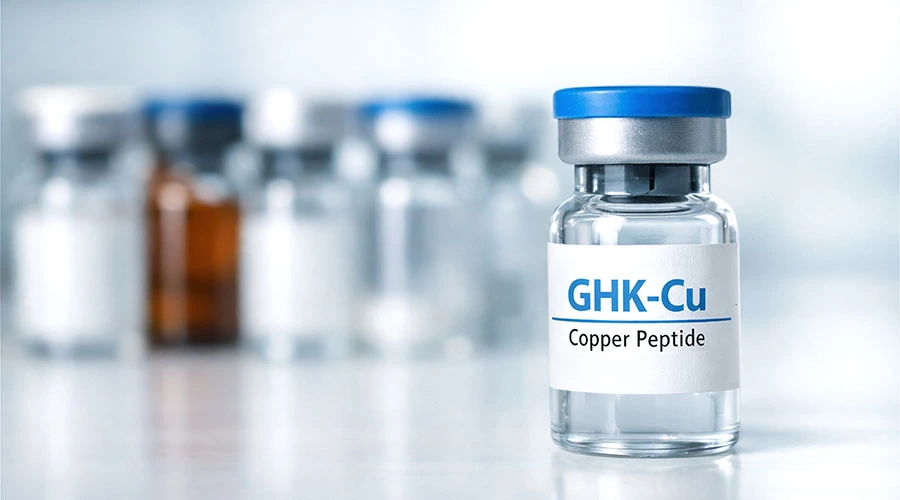
Although laboratory and early clinical findings are encouraging, many proposed uses still require larger, high-quality human studies before they can be considered established treatments.
At Internal Healing & Wellness MD, we evaluate peptide therapies within the broader context of your health, considering factors such as nutrition, hormones, medications, and treatment goals to help you make informed, evidence-based decisions.
Disclaimer: This article is for educational purposes only and does not replace professional medical advice, diagnosis, or treatment. Always consult a qualified healthcare provider before starting any peptide therapy.
Medically reviewed by Dr Imran Khan, MD, ABIM, IFMCP | Last medically reviewed: August 13, 2026
What Is GHK-Cu Peptide?
GHK-Cu stands for glycyl-L-histidyl-L-lysine, a small copper peptide naturally found in human plasma, saliva, and urine.
When GHK binds with copper ions, it forms the GHK-Cu complex, a naturally occurring copper peptide that acts as a signaling molecule, helping cells communicate during normal maintenance and tissue repair.
Unlike hormones, it does not tell organs how to function but appears to influence local repair responses.
What Does GHK-Cu Peptide Support?
Current research suggests the GHK-Cu peptide may support several biological processes involved in repair and regeneration.
However, these are potential benefits observed primarily in laboratory, animal, and early human studies—not guaranteed clinical outcomes.
Skin Repair and Collagen Support
Research into GHK-Cu has largely focused on skin health and visible signs of aging.
- Laboratory studies suggest the copper peptide may support collagen production and collagen synthesis, both of which help maintain skin firmness, elasticity, and healthy skin quality.
- Researchers are also studying whether topical GHK-Cu can support skin repair, skin regeneration, and barrier repair.
- Early cosmetic studies have reported improvements in wrinkle reduction and overall skin health.
- Reviews also note that topical copper peptides have limited natural penetration through the skin barrier, meaning delivery systems play an important role in how much reaches deeper skin layers.
Wound and Tissue Repair
Some of the strongest early evidence for GHK-Cu comes from wound-healing research.
- Laboratory and animal studies suggest the GHK-Cu complex may support tissue repair by encouraging growth factors, tissue remodeling, and new blood vessel formation.
- Researchers are also investigating its potential role in skin healing, dermal wounds, and diabetic wound healing, although these findings have not yet been confirmed in large clinical trials.
- A registered human study is currently evaluating topical GHK-Cu gel for acute wound healing, reflecting growing research interest rather than established medical practice.
Hair and Scalp Research
Interest in GHK-Cu has also expanded into hair growth and scalp health.
- Scientists are studying whether this copper peptide may support healthy hair follicles and the environment needed for normal hair growth.
- Much of the frequently cited research actually involves related copper peptides, such as AHK-Cu, rather than direct studies of GHK-Cu itself.
- At this time, there is not enough high-quality human evidence to conclude that GHK-Cu reliably treats hair thinning or replaces established hair-loss therapies.
Is GHK-Cu Safe?
Safety depends largely on how GHK-Cu is used. Topical GHK-Cu has been used in cosmetic skin care products for years with relatively few reported problems, while much less is known about the safety of injectable GHK-Cu because human research remains limited.
Topical GHK-Cu Safety
Most studies suggest topical copper peptides are well tolerated when used as directed, but product quality and formulation can influence the experience.
Possible side effects include:
- Mild skin irritation, redness, or itching.
- Sensitivity to other ingredients commonly found in creams or serums, such as fragrances or preservatives.
- Temporary dryness or discomfort in people with a weakened skin barrier or certain inflammatory skin conditions.
- Limited information about the long-term effects of frequent, high-concentration use.
Who Should Use Extra Caution?
Additional medical evaluation is recommended if you:
- Are pregnant or breastfeeding.
- Are receiving treatment for active cancer.
- Have a disorder affecting copper metabolism.
- Have significant liver or kidney disease.
- Take multiple prescription medications that require close monitoring.
- Have previously experienced reactions to compounded injections.
- Have open wounds, active skin infections, or other conditions requiring medical assessment before beginning a peptide protocol.
Is GHK-Cu FDA-Approved or Legal?
GHK-Cu is not FDA-approved as a drug for anti-aging, hair growth, skin tightening, or wound treatment.
Its legal status depends on how it is sold and used, since a cosmetic serum, a compounded prescription, and an injectable product fall under different rules.
- Topical products: Some skin care products contain topical copper peptides, but cosmetics are regulated differently from FDA-approved medications.
- Compounded products: A compounded GHK-Cu peptide is not the same as an FDA-approved drug. Compounding rules depend on the ingredient, route of use, product source, and federal and state requirements.
- Injectable GHK-Cu: Injectable use raises added safety and regulatory concerns, including sterility and pharmacy quality.
Important 2026 Compounding Update
FDA records show that GHK-Cu for non-injectable use was removed from Category 1 on April 22, 2026, after nominations were withdrawn.
The FDA later stated that a nominator intended to withdraw only the injectable route, and non-injectable GHK-Cu would be added back to Category 1.
This update does not mean GHK-Cu became FDA-approved or universally legal. It means its compounding status remains under review, so patients should confirm current rules and product sourcing with a qualified medical provider before using any compounded or injectable GHK-Cu product.
Factors That Influence Dosage
There is no universally accepted dosage because research is still evolving, and products vary widely.
A topical GHK-Cu cream, a cosmetic serum, and injectable GHK-Cu are developed differently and should not be used interchangeably.
When deciding whether a product is appropriate, healthcare providers may consider:
- The type of product, such as a topical peptide or compounded injectable.
- The intended purpose, whether for skin care, skin repair, or another investigational use.
- The concentration and formulation of the copper peptide.
- Your skin condition, overall health, medical history, and any other medications or therapies you use.
- How your skin responds, including any skin irritation or sensitivity during treatment.
Integrating Functional Medicine into Peptide Therapy
Because no two patients have the same health history or goals, peptide therapies are evaluated as part of a broader functional medicine assessment rather than as a stand-alone solution.
Your care plan may consider:
- Skin, hair, or healing concerns.
- Medical history and current medications.
- Hormone, thyroid, and nutritional health.
- Inflammation, lifestyle, and wellness goals.
- Product quality and the intended route of use.
When appropriate, GHK-Cu may be incorporated into a personalized plan alongside nutrition, lifestyle changes, and other evidence-informed therapies—not as a replacement for comprehensive care.
Disclaimer: This article is for educational purposes only and does not replace professional medical advice, diagnosis, or treatment. Always consult a qualified healthcare provider before starting any peptide therapy.
Explore Personalized Skin and Hair Wellness
At Internal Healing & Wellness MD, we provide comprehensive functional medicine evaluations that consider your skin concerns, medical history, medications, supplements, and overall wellness before recommending any treatment.
When appropriate, we also coordinate care with your dermatologist or other specialists to help you pursue safe, realistic, and long-term results.
Schedule a consultation today to learn whether GHK-Cu or another personalized approach is the right fit for your health goals.
Frequently Asked Questions
Yes, GHK-Cu peptide products can sometimes be used alongside retinol or vitamin C, but introducing multiple active skin care ingredients at once may increase the risk of irritation.
Start slowly, monitor your skin's response, and ask a dermatologist or qualified healthcare provider if you're unsure.
Store topical GHK-Cu according to the manufacturer's instructions, away from excess heat, moisture, and direct sunlight.
If the product changes color, smell, or texture before its expiration date, stop using it and replace it with a new one.
For most people, applying a copper peptide to the skin is not the same as taking copper supplements. However, if you have a disorder that affects copper metabolism or have been told you have high copper levels, speak with your healthcare provider before using GHK-Cu products.
Changes in skin quality, wrinkle reduction, or overall skin health usually take several weeks or months, and some people may notice little or no visible improvement.
Results depend on the product used, your skin condition, and your overall skincare routine.
Look for products from reputable manufacturers that clearly list their ingredients, concentration, expiration date, and testing practices.
Choosing a trusted source can help reduce quality concerns and improve confidence in the GHK-Cu peptide product you're using.
References
- Arciola, C. R., Panichi, V., Bua, G., Costantini, S., Bottau, G., Ravaioli, S., Capponi, E., & Campoccia, D. (2026). Smart healing for wound repair: Emerging multifunctional strategies in personalized regenerative medicine and their relevance to orthopedics. Antibiotics, 15(1), 36. https://doi.org/10.3390/antibiotics15010036
- Choi, H.-R., Kang, Y.-A., Ryoo, S.-J., Shin, J.-W., Na, J.-I., Huh, C.-H., & Park, K.-C. (2012). Stem cell recovering effect of copper-free GHK in skin. Journal of Peptide Science, 18(11), 685–690. https://doi.org/10.1002/psc.2455
- Mortazavi, S. M., Mohammadi Vadoud, S. A., & Moghimi, H. R. (2024). Topically applied GHK as an anti-wrinkle peptide: Advantages, problems and prospective. Bioimpacts, 14(eCollection 2025), 30071. https://doi.org/10.34172/bi.30071
- Pickart, L., & Margolina, A. (2018). Regenerative and protective actions of the GHK-Cu peptide in the light of the new gene data. International Journal of Molecular Sciences, 19(7), 1987. https://doi.org/10.3390/ijms19071987
- Zheng, X., Wang, N., Ma, H., Xu, Z., Wu, W., Liu, W., Fu, M., & Han, L. (2026). EGCG–Biotin–Pal–GHK composition modulates TGF-β and BMP pathways in scalp microenvironment for treating stress-induced alopecia. European Journal of Pharmacology, 179217. https://doi.org/10.1016/j.ejphar.2026.179217


