


Medically Reviewed By: Dr. Imran Khan, MD, IFMCP
Last Updated: April 22, 2026
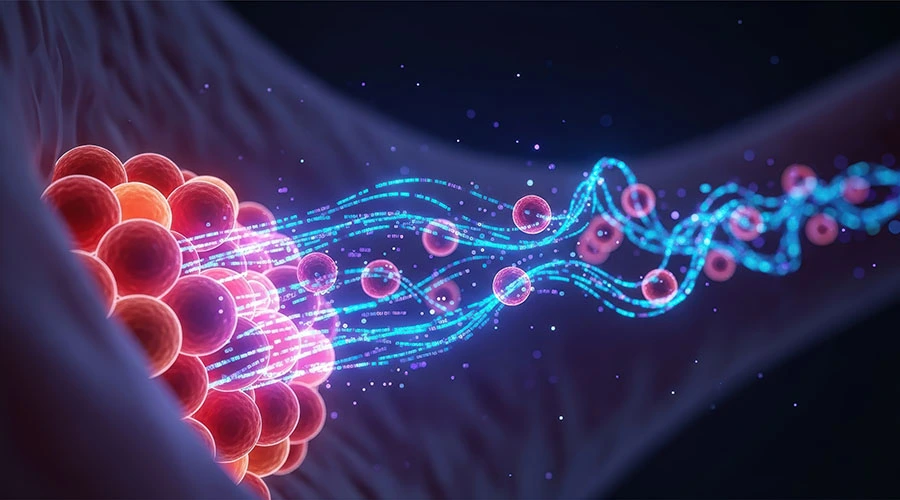
How Circulating Tumor Cells Appear in the Bloodstream
Circulating tumor cells, often called CTCs, are cancer cells that break away from a primary tumor and enter the bloodstream. These tumor cells travel through the blood alongside red blood cells and white blood cells and may play a role in how cancer spreads to other parts of the body.
At Internal Healing and Wellness MD, circulating tumor cell testing may be discussed when reviewing personalized cancer insights and integrative oncology approaches. Studying these rare circulating tumor cells may help researchers better understand cancer progression and how tumor cells behave once they enter the bloodstream.
Disclaimer: This content is for informational purposes only and does not replace medical advice. Always consult a qualified healthcare provider before making health decisions.
Why Circulating Tumor Cells Matter in Cancer Research
Scientists study circulating tumor cells to better understand cancer metastasis. When tumor cells move from the primary tumor into the bloodstream, they may travel to other parts of the body and form metastatic lesions.
Research involving breast cancer, prostate cancer, colorectal cancer, and small cell lung cancer shows that circulating tumor cells may provide insight into how cancer behaves. In some cases, circulating tumor cell clusters or grouped tumor cells may be associated with disease progression.
Circulating tumor cells may also be studied in conditions such as:
- breast cancer and metastatic breast cancer
- prostate cancer and metastatic prostate cancer
- colorectal cancer
- hepatocellular carcinoma
- other forms of metastatic disease
These rare cancer cells can offer researchers clues about cancer progression and possible treatment responses.
How Circulating Tumor Cells Are Measured
Circulating tumor cells are usually measured using specialized blood tests. These tests analyze a blood sample taken from peripheral blood to look for tumor cells that may be present in the bloodstream.
Because circulating tumor cells are rare, advanced laboratory techniques are often required to detect them. In some cases, testing may also analyze circulating tumor DNA or other signals related to tumor activity.
Common laboratory approaches may include:
- detecting circulating tumor cells in a blood sample
- identifying markers on tumor cells such as epithelial cell adhesion molecule
- analyzing tumor DNA or circulating tumor DNA
- examining tumor cell clusters or grouped circulating tumor cells
These tests are sometimes described as a type of liquid biopsy because they evaluate tumor-related signals using a blood sample rather than tissue taken directly from a tumor.
What Researchers Learn From Circulating Tumor Cells
Studying circulating tumor cells can provide information about how cancer cells behave in the body. Researchers often analyze these cells to understand changes related to cancer progression or cancer metastasis.
For example, circulating tumor cells may help researchers examine:
- how tumor cells enter the bloodstream from a primary tumor
- how cancer cell metastasis may occur
- whether tumor cells appear as individual cells or clusters
- how cancer may change over time
Some studies also look at how circulating tumor cells interact with immune cells in the bloodstream. Understanding these interactions may provide further insight into disease progression.
Circulating Tumor Cells and Liquid Biopsy Testing
Because circulating tumor cells can be detected through blood tests, they are sometimes used in liquid biopsy approaches. Liquid biopsy refers to tests that analyze cancer-related signals in blood rather than using traditional tissue biopsies.
In certain research settings, circulating tumor cells detected in peripheral blood may help provide a snapshot of tumor biology. These insights may support discussions about personalized cancer care and ongoing cancer monitoring.
Some laboratories also study circulating tumor cell clusters and tumor cell patterns to understand how cancer spreads in metastatic disease.
Learn More About Circulating Tumor Cell Testing
Patients interested in understanding circulating tumor cells and molecular cancer testing may wish to explore circulating tumor cell analysis and liquid biopsy approaches in more detail.
You can learn more about RGCC circulating tumor cell testing and molecular cancer analysis to better understand how this type of testing is used in integrative oncology discussions.
Disclaimer: This content is for informational purposes only and does not replace medical advice. Always consult a qualified healthcare provider before making health decisions.
Speak With Our Care Team Today
If you are interested in how circulating tumor cells are used in cancer research and testing, our team can help explain your options. We guide patients through circulating tumor cell analysis and how it may provide additional insight alongside standard cancer care.
Schedule a consultation with Internal Healing and Wellness MD today.
Frequently Asked Questions
Circulating tumor cells are cancer cells that break away from a primary tumor and travel through the bloodstream.
Researchers study circulating tumor cells because they may provide clues about cancer metastasis, disease progression, and tumor behavior.
Circulating tumor cells are usually detected through specialized blood tests that analyze a blood sample for rare cancer cells.
Circulating tumor cells have been studied in several cancers, including breast cancer, prostate cancer, colorectal cancer, and small cell lung cancer.
Circulating tumor cell testing is sometimes called a liquid biopsy because it analyzes tumor-related signals in blood rather than using tissue from a tumor.
References
Asafo-Agyei, K. O., & Samant, H. (2023). Hepatocellular carcinoma. StatPearls Publishing. https://www.ncbi.nlm.nih.gov/books/NBK559177/
Litvinov, S. V., Balzar, M., Winter, M. J., Bakker, H. A. M., Briaire-de Bruijn, I. H., Prins, F., Fleuren, G. J., & Warnaar, S. O. (1997). Epithelial cell adhesion molecule (Ep-CAM) modulates cell–cell interactions mediated by classic cadherins. The Journal of Cell Biology, 139(5), 1337–1348. https://doi.org/10.1083/jcb.139.5.1337
National Cancer Institute. (n.d.). Liquid biopsy. In NCI dictionary of cancer terms. Retrieved March 12, 2026, from https://www.cancer.gov/publications/dictionaries/cancer-terms/def/liquid-biopsy
ScienceDirect. (n.d.). Metastatic breast cancer. Retrieved March 12, 2026, from https://www.sciencedirect.com/topics/pharmacology-toxicology-and-pharmaceutical-science/metastatic-breast-cancer
World Health Organization. (2026, February 13). Colorectal cancer. https://www.who.int/news-room/fact-sheets/detail/colorectal-cancer
Yu, M., Stott, S., Toner, M., Maheswaran, S., & Haber, D. A. (2011). Circulating tumor cells: Approaches to isolation and characterization. The Journal of Cell Biology, 192(3), 373–382. https://doi.org/10.1083/jcb.201010021


